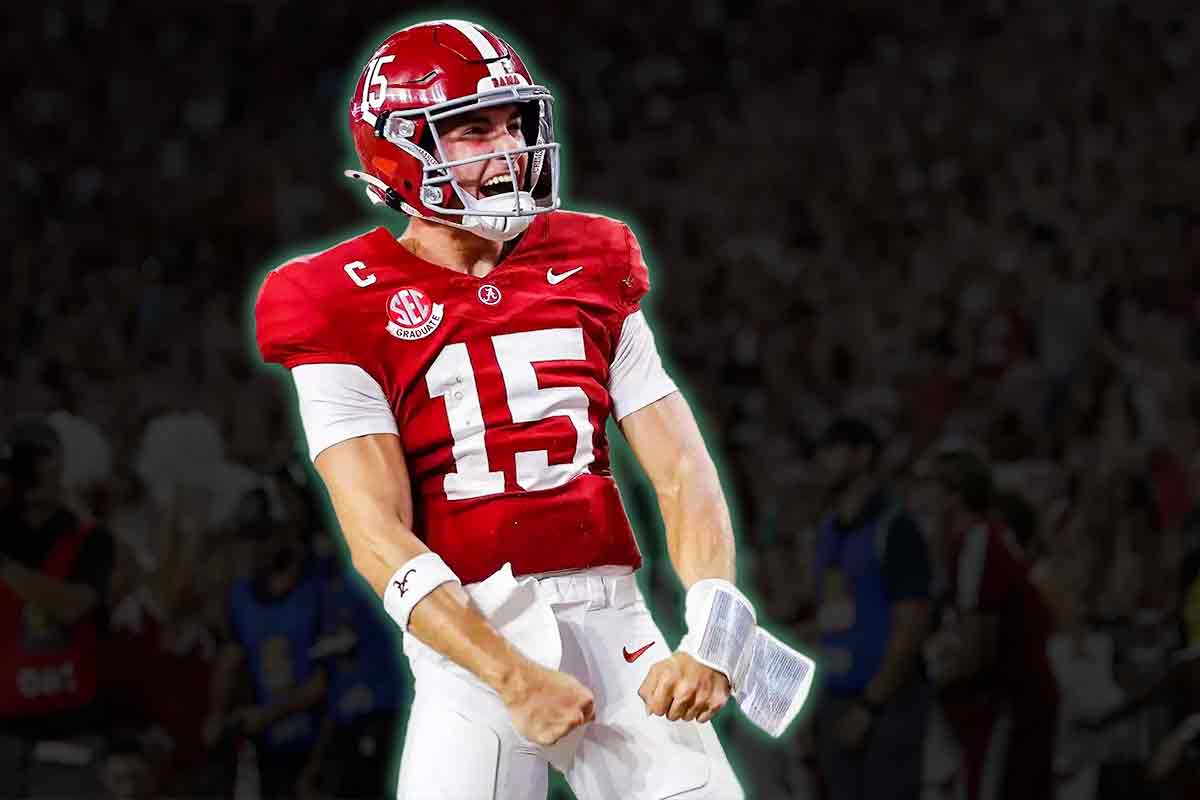
When a quarterback only has fifteen starts under his belt we typically see him return to college or flame out in the NFL. Ty Simpson will have to prove that he can handle the speed and rigor of the next level and I have to be honest, after watching his film, I think he can do it.
For the record, the whole thing about starts is a little overblown by recency bias and needs more context. We simply can’t lump all the quarterbacks with fewer than twenty starts into the same group. Anthony Richardson and Trey Lance have become the poster boys for first-round quarterbacks with limited starts but the questions surrounding them were more related to accuracy, mechanics and ability to read defenses. Simpson excels in all three of those categories.
On the flipside, players with a ton of collegiate experience can flame out too! Kenny Pickett and Paxton Lynch were first-round picks with 38+ starts and clearly, neither left much of an impression on the league.
Simpson is the son of UT Martin head coach Jason Simpson, so we know he’s grown up around football and learned every little bit he possibly could. He’s a very mechanically sound passer who can make every throw on the field. But the stuff that goes unnoticed is all between the ears. He’s a cerebral player who was given full autonomy to change plays and set pass protections at the line of scrimmage. As I mentioned before, Simpson isn’t your typical inexperienced passer.
At Alabama, he ran a lot of up-tempo plays, particularly in third and long situations, to get the defense frazzled. The speed of the NFL is usually the toughest part of transitioning for a quarterback prospect, but Simpson seems to already have a level of comfort with a faster-paced offense.
He doesn’t have elite arm strength by any means, but his arm is strong enough to hit the deep ball with regularity, and he can quickly identify man coverage on those deep routes against a single high safety. He’ll often motion players to determine the coverage, a concept that isn’t new or rare to the NFL, but it’s not as common at the college level. Alabama utilizes a lot of pro concepts that should be second nature to Simpson when he gets to training camp.
Through the first eight weeks of the college football season, Simpson was widely considered the best quarterback in the nation, that is, until injuries started to pile up on him. From Week 8 on, Simpson was dealing with a bulging disc, gastritis (which caused him to lose twenty pounds), elbow bursitis and finally, a fractured rib in the Rose Bowl against Indiana.
PSA: I’m just a writer and podcaster, so if I had even one of these things happen to me, I’d probably just curl into the fetal position.
Before the Injuries, Simpson was averaging a 68% completion rate, 273 passing yards per game, and a 20-1 TD to INT ratio. The pile up of injuries can be a Rorschach test. Either you believe that the guy playing before he got hurt is who he truly is, or you tell yourself that NFL players have to deal with injuries all the time and Simpson needs to be able to overcome those extenuating circumstances at the next level.
I believe the truth is somewhere in between those two schools of thought. The upside we saw is very real, but he’ll need to protect himself more at the next level.
When it comes to being pro-ready, Simpson is actually further along than most guys in his situation have been. According to our Reception Perception charting, Simpson faced zone coverage 59.6% of the time, the highest percentage of the quarterbacks charted by at least 6%. This should help him in his transition to the pros, where defenses are in zone coverage approximately 70% of the time.
He is really sharp on dagger concepts and dig routes against zone coverage, where he had a 73.9% success rate, highest among the FBS quarterbacks charted. Those middle of the field concepts are going to be so important at the next level because it means that offensive coordinators don’t need to hold back on their play concepts. They can attack the middle of the field and work the intermediate zone. Typically, we see quarterbacks with Simpson’s low number of starts get brought along slowly, with simpler concepts and quick reads that get the ball out fast without having to think too much. With his mental capacity, coordinators should be able to give Simpson a full playbook out of the gate and watch him execute.
While pretty much every college quarterback is running their offense out of shotgun or pistol, Alabama had Simpson undercenter on 8.8% of his charted pass attempts, which was leaps and bounds higher than any other FBS quarterback charted by reception perception. On the surface that seems like a small thing, any quarterback can easily learn how to play under center and get their footwork right, but for Simpson, this means he has one less thing to learn and practice in training camp. He’ll be able to get straight to install and learn the playbook.
My favorite part of Simpson’s game is how well he throws on the run. Alabama ran a lot of play-action rollout concepts that he was able to run from under center. His 19% of attempts out of the pocket were second among FBS quarterbacks charted, only behind Taylen Green, who is being considered as a receiver by some scouts. This specific skill set would work really well in a West Coast-style offense.
It’s easy to look at Simpson’s 44.8% success rate on deep passes, but it’s important to remember that going against zone coverage more often than any other player will have that effect. Inversely, that’s also a big reason why Simpson was charted for nearly half as many contested catch attempts. He’s often throwing to windows in the zone, rather than tossing the ball up to a player who’s covered.
Simpson didn’t face man coverage as often as the other quarterbacks that were charted, just 39.1%, he can quickly identify man coverage with the use of motioning players to determine the coverage, a concept that isn’t new or rare in the NFL, but it’s not as common at the college level. Alabama utilizes a lot of pro concepts that should be second nature to Simpson when he gets to training camp. on those deep routes against a single high safety.
In his short college career, we got to see him overcome an unusually bad Alabama offensive unit that dropped too many passes and couldn’t run the ball. While the lack of college starts and the string of injuries are obvious red flags on his scouting report, I’m still a believer in Simpson’s upside, and I think the caveat that “with patience and in the right situation, he can be good” applies to every quarterback that gets drafted, not just him. So, for good measure, I’ll say it one more time. With patience and in the right situation, Ty Simpson can be a good NFL quarterback.