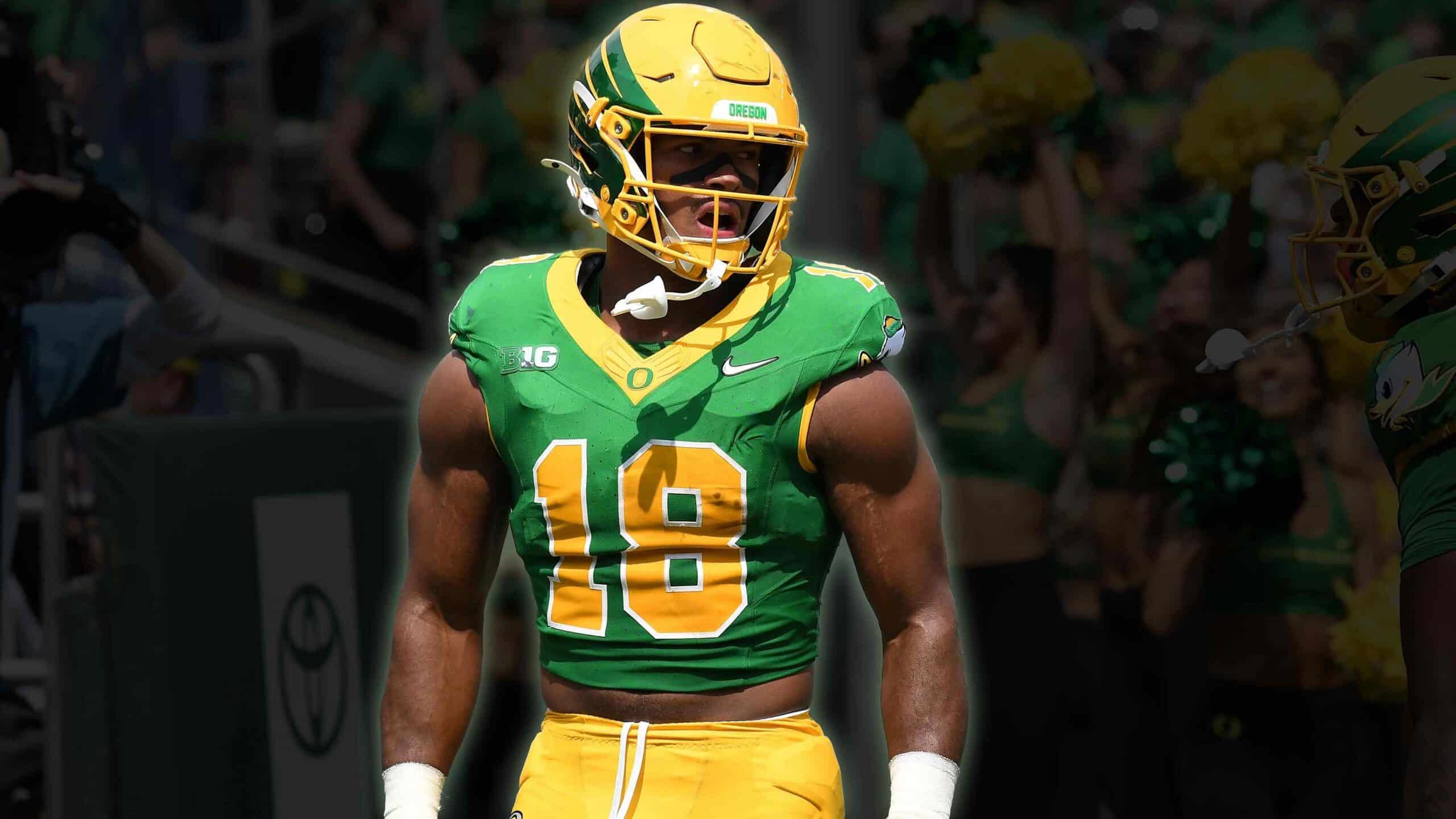
Kenyon Sadiq has been the presumptive alpha-dog of the 2026 tight end class since the summer. He arrived at Oregon in 2023 as a top 100 recruit and developed behind a future NFL starter in the Rams’ Terrance Ferguson. Combined with his blazing 4.39 speed and athletic explosiveness, NFL scouts are salivating.
But despite the hype, RP charting profiles Sadiq more as an enigma.
Success Rate by Route
Route Percentage
Blocking Success Rate
Sadiq’s field-stretching speed was used in a variety of alignments at Oregon. A chunky 19.8% of his routes came from a true slot alignment. Another 11.4% of his routes came from an outside WR spot.
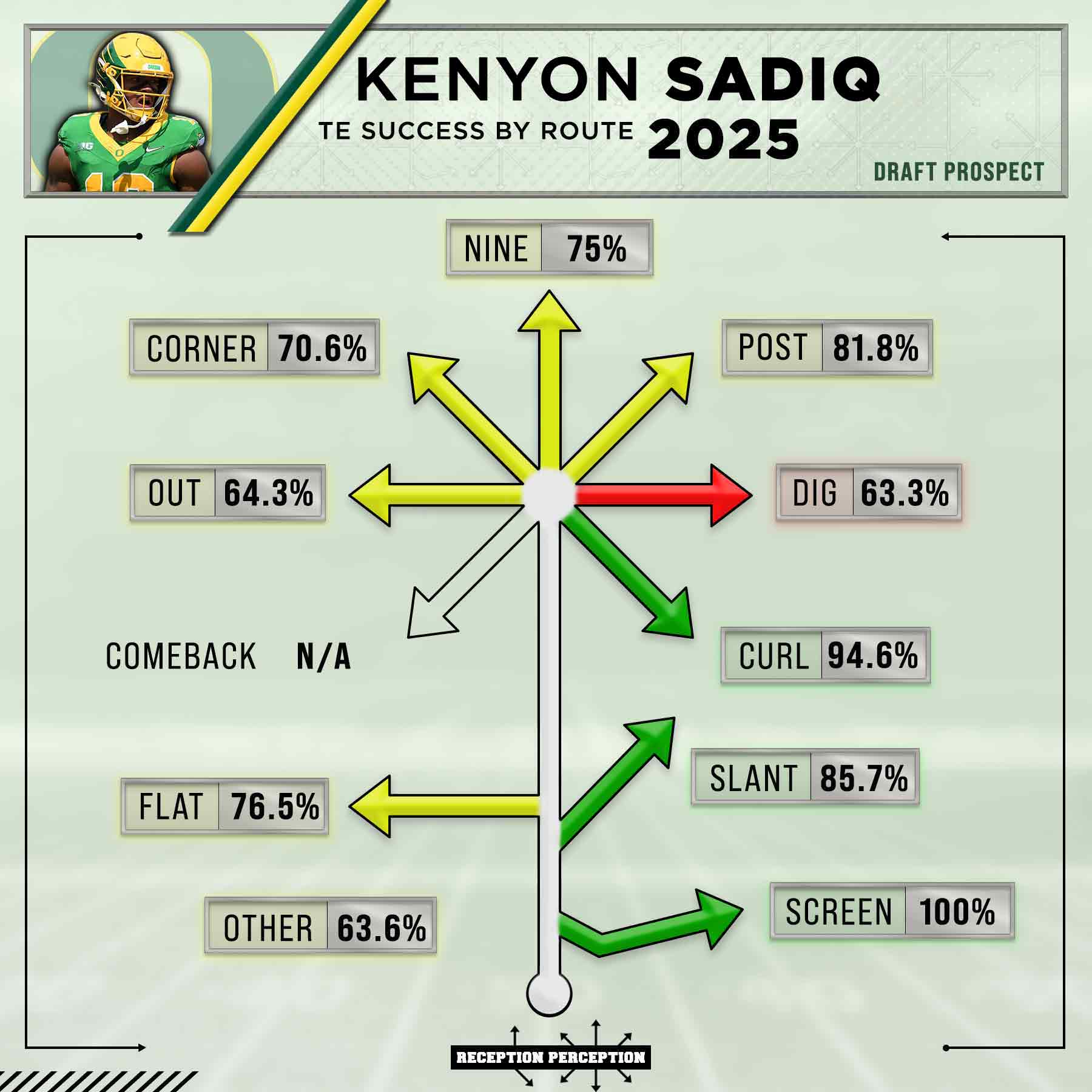
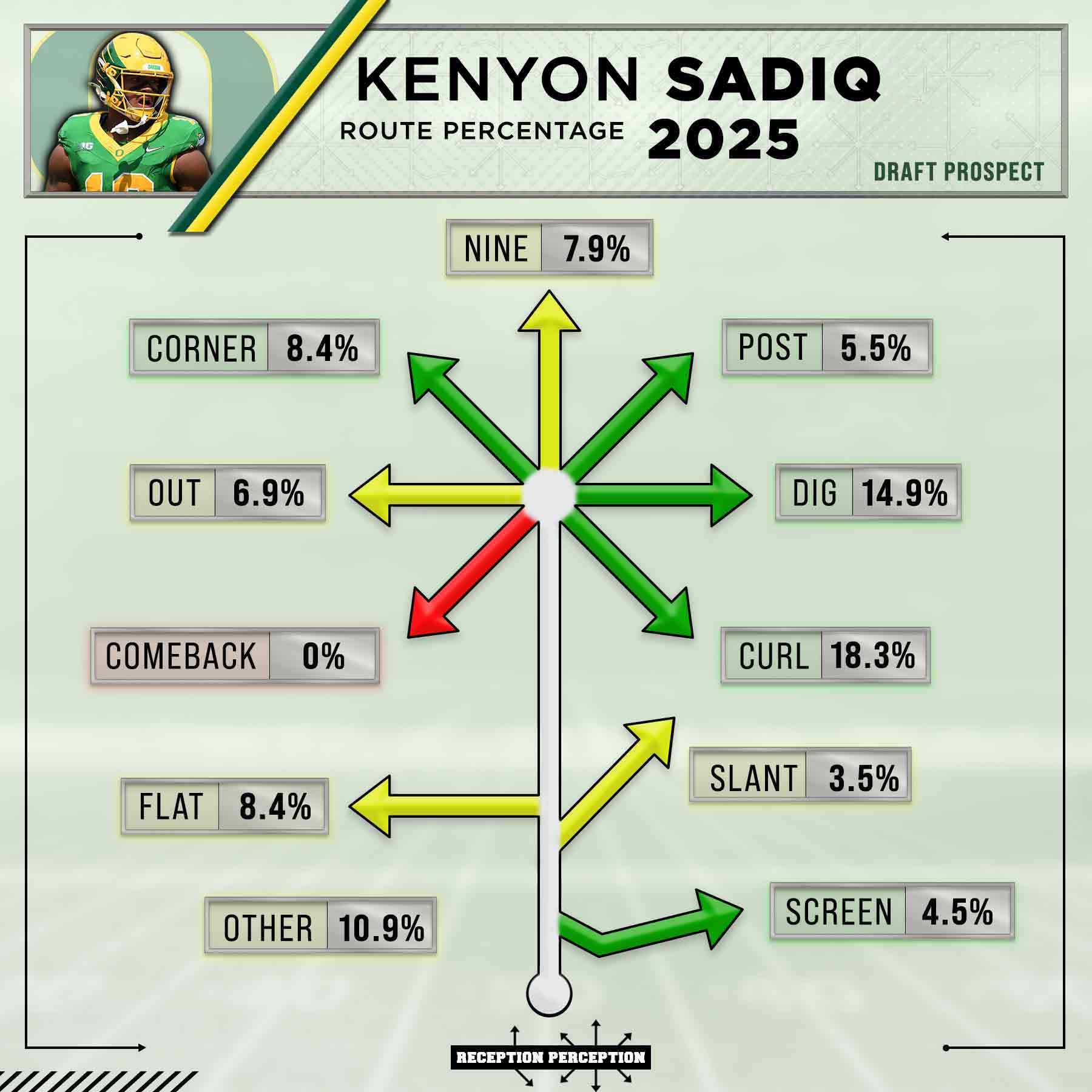
He is mainly a weapon on static and linear routes. He gets a lot of run on curl-type routes to space out the underneath zones and get him moving after the catch. This route alone covers 18.32% of his usage at a blistering 94.59% success rate.
There is plenty of short-area quickness to go along with his speed, especially when in the slot. This makes him dangerous on quick movement routes such as slants. He posted a strong 85.71% success rate despite limited usage. Against zone coverages, he can be a serious weapon on choice routes either to the strength in the slot or weakside on the WLB.
Despite not being a frequent deep target as a TE (nine routes accounted for just 7.92% of his arsenal) his rare speed was weaponized vertically in a number of ways. Not only did he routinely stretch linebackers vertically in the intermediate, working out of the slot, he was effective as a deep clearout guy, stressing safeties.
Given his tempo and feel for space, Sadiq was a menace along the seams. He regularly cleared the second level quickly, making it nearly impossible for linebackers to recover back and squeeze on a player.
But while Sadiq is vertically fast and also quick underneath, he has some issues slamming the brakes and sinking into his hips when he has momentum. The rounded cuts and breaks created by poor deceleration and balance allowed DBs to react and close despite his elite straight line speed. Think of him like a fast car with old shocks. This shows up on his profile with more ho-hum success rates on routes involving deceleration and complex change of direction.
He posted just a 64.29% success rate on outs, 63.33% on digs, and 70.59% on corners. Luckily for Sadiq, the Ducks faced man coverage on just 43 snaps across his charted sample. His 62.79% success rate isn’t glaring but the routes on which he thrives do not beat man coverage.
This all forms the typical receiving profile for an explosive, but low-volume Y TE in the NFL.
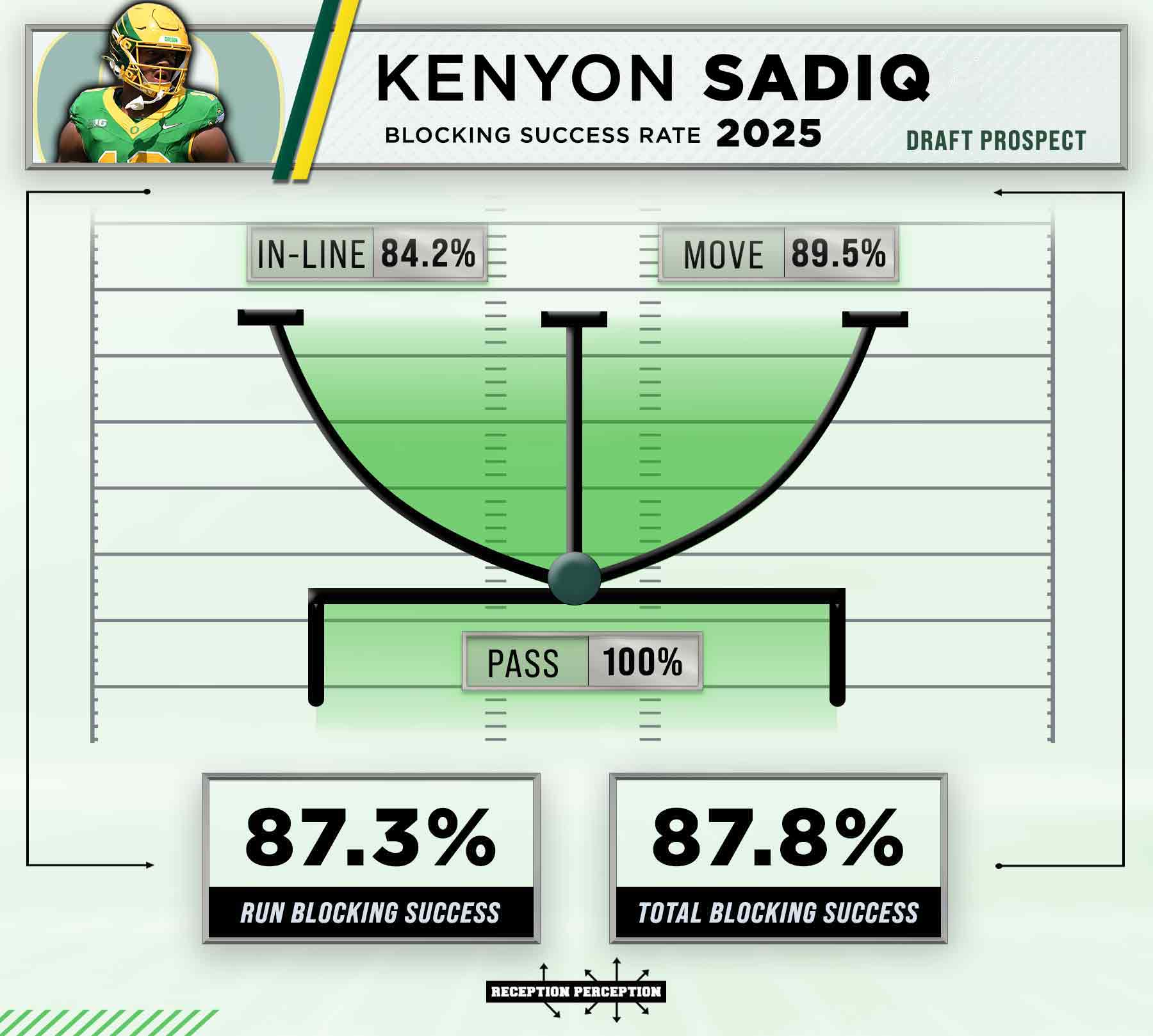
Receiving is not Sadiq’s only responsibility. His effort and willingness as a blocker are the stuff of dreams among TE coaches and run-game coordinators. He posted a solid 84.21% success rate in-line in a role that did not shelter him from handling defensive ends on the playside of runs. Despite that, a majority of his use took place on the move. Oregon pulls the TE frequently in their counter-heavy run game. Sadiq is really solid on the move at a nearly automatic 89.52% success rate.
Projecting Sadiq is an interesting proposition. There are plenty of great TEs with his receiving profile. Unlike at WR, a real route-tree and functionality against man coverage are not always requirements at the TE position. Fundamentally, the bulk of the receiving volume and work in an offense belongs to the true wideouts. The baseline job of a solo TE in the passing game is to do more than an extra OL would. Mission accomplished emphatically in this regard, but things get a bit more nuanced than that.
Sadiq’s receiving game is almost identical to that of Tucker Kraft. He’s a big producer, but you could argue that he’s fourth on the totem pole in terms of target getters for Green Bay.
Like Sadiq, Kraft struggles to decelerate and is a non-factor on anything but static quick game, screens, linear seams, wheels, and schemed-up run-action gadgetry. But what sets Kraft apart is that in addition to his receiving work, he’s 260 pounds and dominant on the line of scrimmage.
The 241-pound weight and lack of upper-body strength of Sadiq concern me in-line at the NFL level. While I think he can get to a place where he clears the minimum strength requirements, a TE who can’t command receiving volume needs to do even more than that as a blocker.
Sadiq has a decent chance to get to the level of Sam LaPorta or TJ Hockenson on the line with continued physical maturation. The two NFC North Hawkeye products make their money as volume eaters who can threaten on a variety of routes against any coverage. Sadiq does not profile nearly as well in that regard as they did respectively at Iowa.
In a 12-personnel flex capacity where you need to assume a lot of the slot’s responsibility, that would become even more of an issue.
Where I do think he would thrive would be in places like Baltimore, Washington, or on any team with a QB-driven run game. There is more of a need in those systems for a move-blocking, run-action threat in the flex role than in the typical NFL offense. We’ve seen players like Isaiah Likely do well in these roles even if they are rotational in nature.
If the route-running and physical strength develop a little bit, there’s a path to every-down stardom for the projected first-rounder. That being said, the path is a bit too murky for me to sign on to his first-round grade.