Let’s start with the broad strokes: I’m here to chart tight ends. As I start compiling data and writing about this position group my hope is that I’ll be able to introduce this incredible audience to my process, lane of analysis and all of that.
Site editor James Koh asked me to write a piece introducing myself but I can’t talk about how I got here without first saying that, to me, it is truly an honor of a lifetime to be here.
Reception Perception is great in large part due to the vision and skill of Matt Harmon, who has revolutionized receiver analysis. But there is another piece to the equation and that is you all. Reception Perception is great not only because of the data but also because of its community.
As a brand, they’ve cultivated an audience of the sharpest, most curious consumers that our great game has to offer. I extend my gratitude to you for the opportunity to serve you and satisfy that curiosity, but also for what you have done to make us all better and improve the public’s understanding of the game. The entire football-watching public, from X’s and O’s savants to the most casual fan, benefit from the demand you create for better work. Thank you.
I am, in every way you can imagine, one of you. This all started for me in 5th grade on the football field itself. Those of you unfamiliar with me may think this is the start of a playing career, but it’s actually the beginning of the end of it.
At that point, it had been three years of being the smallest, least athletic kid on the field. I began to understand that, despite the fun I was having, I wasn’t good and my days doing this were numbered as the “let everyone play” edict in youth sports became less of a consideration the older we got.
Route Success Rate
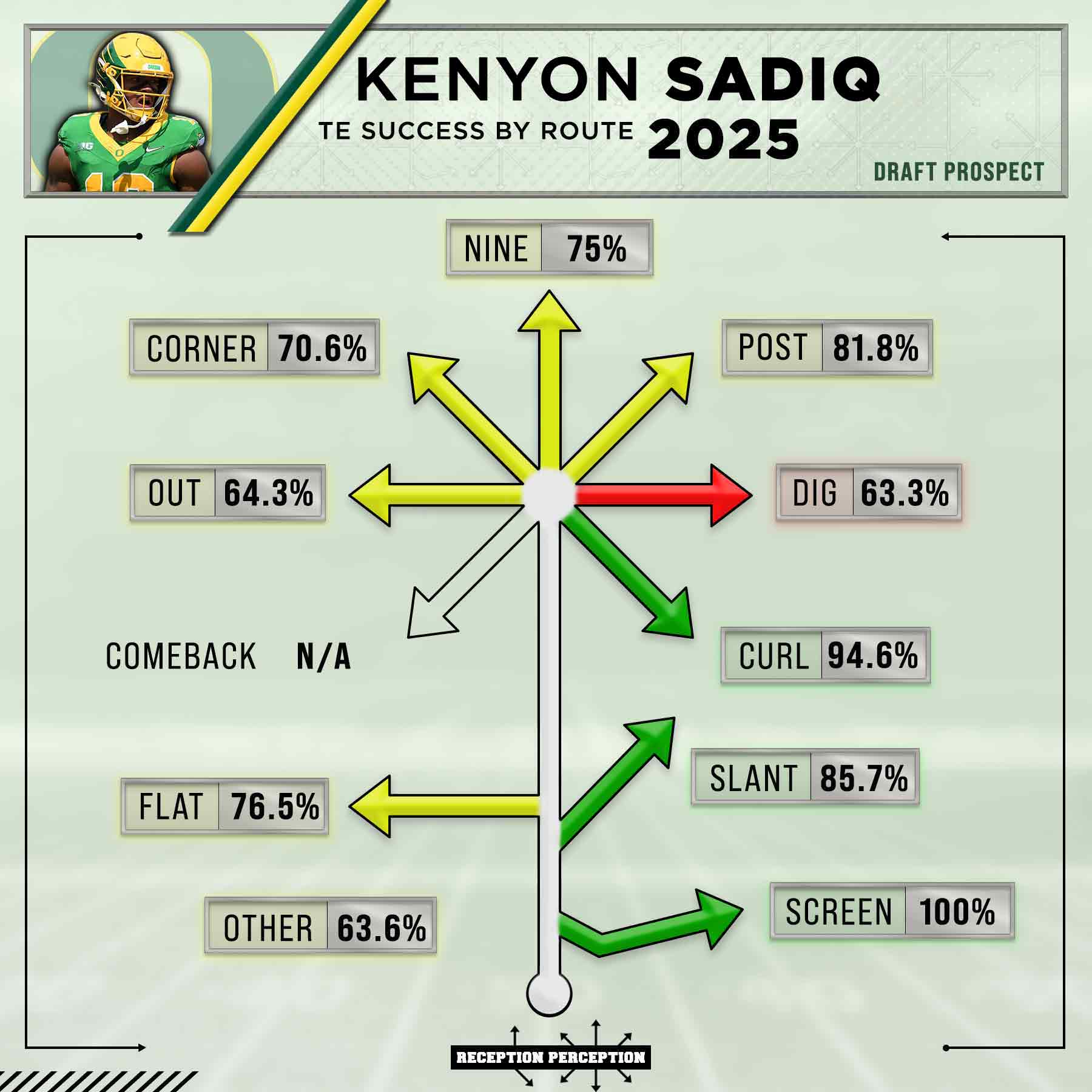
What was so special about 5th grade? Well, it’s simple. That was the year we started running more plays than just “left and right.” My body wasn’t cooperative, but a flame was lit in my mind that only grew and spread.
The complexities of this game got me going like nothing else ever had. I would sit up in bed studying my simple playbook, staying after practice to pepper the coaches with questions that they frankly had no idea how to answer. My idle mind would race thinking about football.
Fast forward to the spring of 2015. In a desperate effort to figure out why the quarterbacks of my beloved LSU Tigers were so bad, I scoured the internet for answers. I’m weird but I have this need to understand the deepest possible root of everything; generalities are never enough for me.
It was at this point that I discovered X’s and O’s analysis. There were people out there doing work that scratched my itch and fed, like a king, the voracious appetite of my curiosity.
I was inspired by pioneering titans like Chris Brown, Seth Galina, Ted Nguyen, Chris Vasseur, Cody Alexander, Dan Casey, Taylor Kolste, and some guy named Matt Harmon.
I read, and read, and read. I asked questions. I watched online clinics. I dug up playbooks and chased every rabbit hole I could down. From there, I started writing in college. After college, I did a season-long internship with the Mora regime at UConn in its first year.
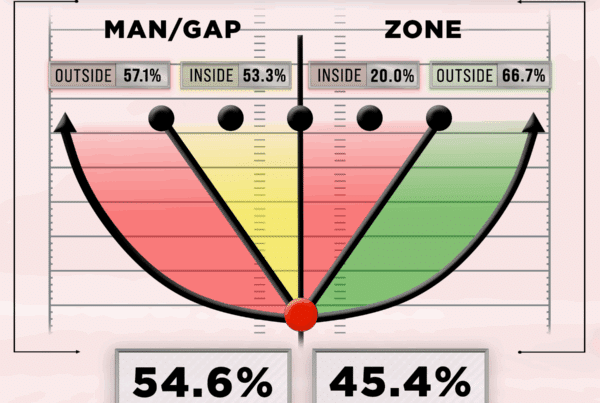
Blocking Success Rate
There, I learned how the sausage is actually made and it put all of the gathered knowledge together. As a writer, I started at SB Nation’s And The Valley Shook in 2020, the same place I discovered X’s and O’s writing. I have since expanded to breakdowns for Bengals Talk on Sports Illustrated.
The more I studied football, the more I came to realize that if you wanted to understand the 500-level complexities of offensive football, the TE position is the place to look.
Our game is changing, folks. The defensive meta has flipped on its head. No longer will a defense simply commit first to the run. Previously, that was dogma. You committed everything you could to run defense and worked backward from there.
But somewhere along the way, the “flex” TE was born and slowly began to take the place of the traditional “in-line” guys. And as spread offenses also proliferated, putting these gifted athletes in a position to feast on old school TE matchups became a cheat code.
Naturally, defenses adjusted and switched to a pass-first approach. All of a sudden, that cheat code became a drain. You will hear so much more detail about all of this as we get going.
A little while back, I noticed that so few people were talking about this and also began seeing that some teams were totally unaware as well. To fill that void, and hopefully to reshape the conversation, I began a Substack, titled “Remember The Tight Ends” to try and Paul Revere this thing by shining a light on the importance of a position that, in my opinion, is not discussed nearly enough.
In my mind the TE is the bellwether of all offensive changes, yet so little is understood about it; from what TE blocking actually is, to the differences in the passing game relative to receivers.
The position has its own unique language and as Matt has done with the WR position, I am honored to finally provide digestible, engaging data to the public that speaks TE.
Hopefully, this position will soon no longer be such an enigma, as it is in everything ranging from fantasy to the draft.
The 15-year-old kid who started this journey cannot believe he has the privilege to feed your curiosity and potentially create the sense of wonder that I was so lucky to stumble across all those years ago. Doing such a thing under the banner of Matt Harmon, who still does that for me to this day, is particularly unbelievable.
Let’s break new ground together.