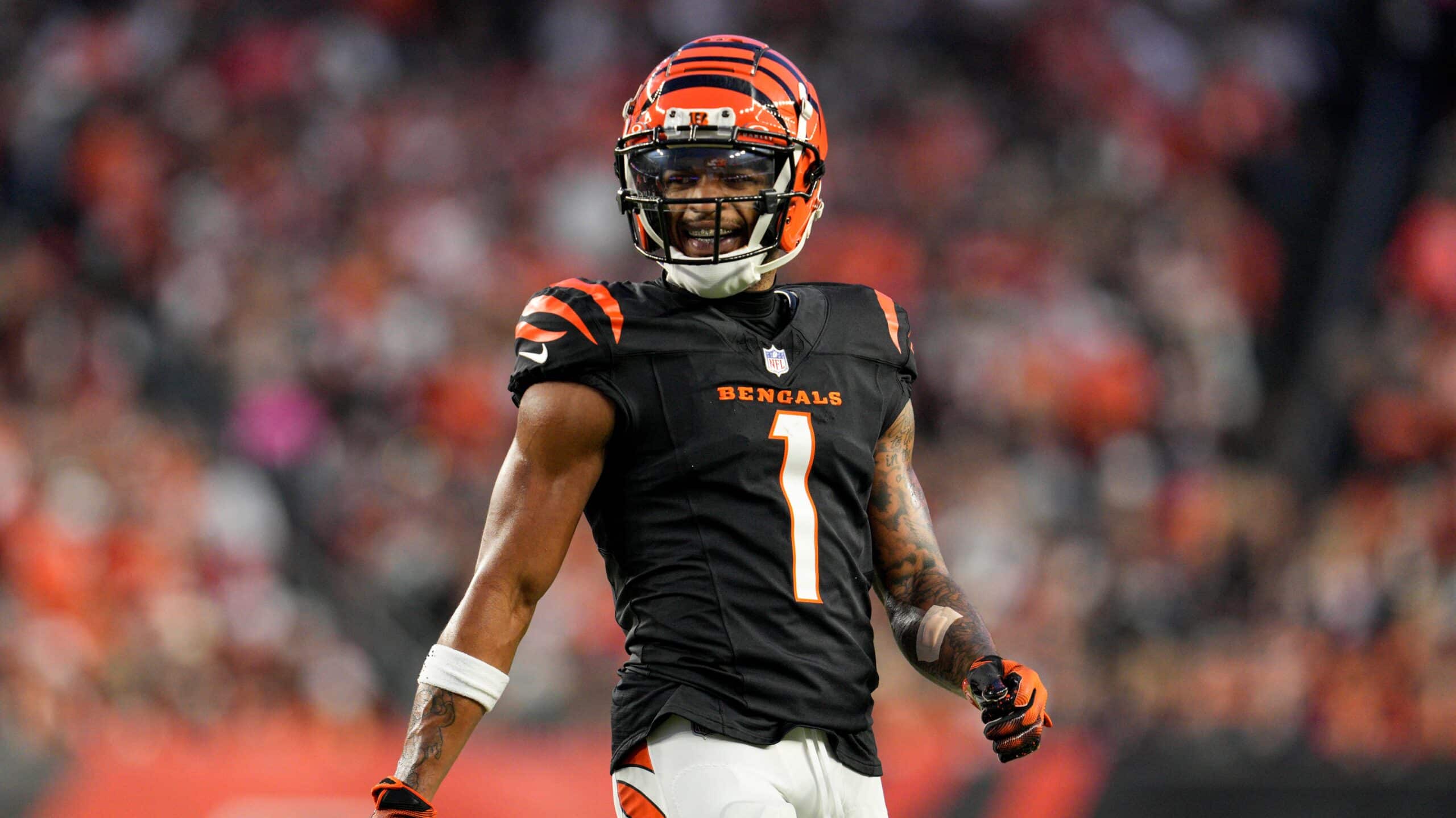
Coming off a year in which he won the Triple Crown and ran roughshod over the league, Ja’Marr Chase has firmly established himself as one of the two best wide receivers in football. He stepped right into the league in 2021 and was a high-end starter at the X-receiver spot from Week 1 and he’s only gotten better since. The 2024 season was the biggest testament yet to Chase’s status as an elite wideout. It was also a massive example of how moving your No. 1 wideout around to create dynamic deployment can unlock a new ceiling for player and team. All that is perfectly laid out in his Reception Perception charting data.
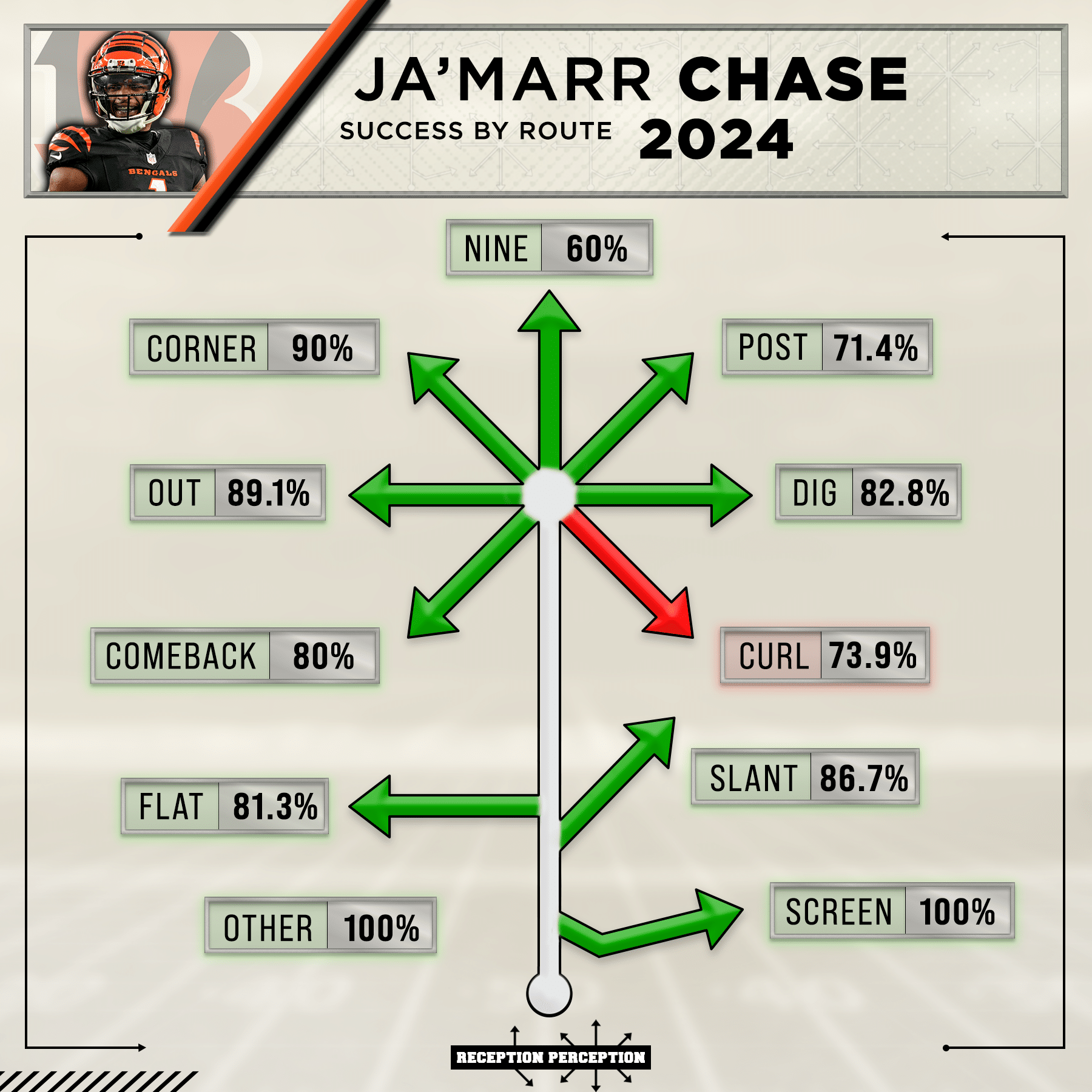
Success Rate by Route
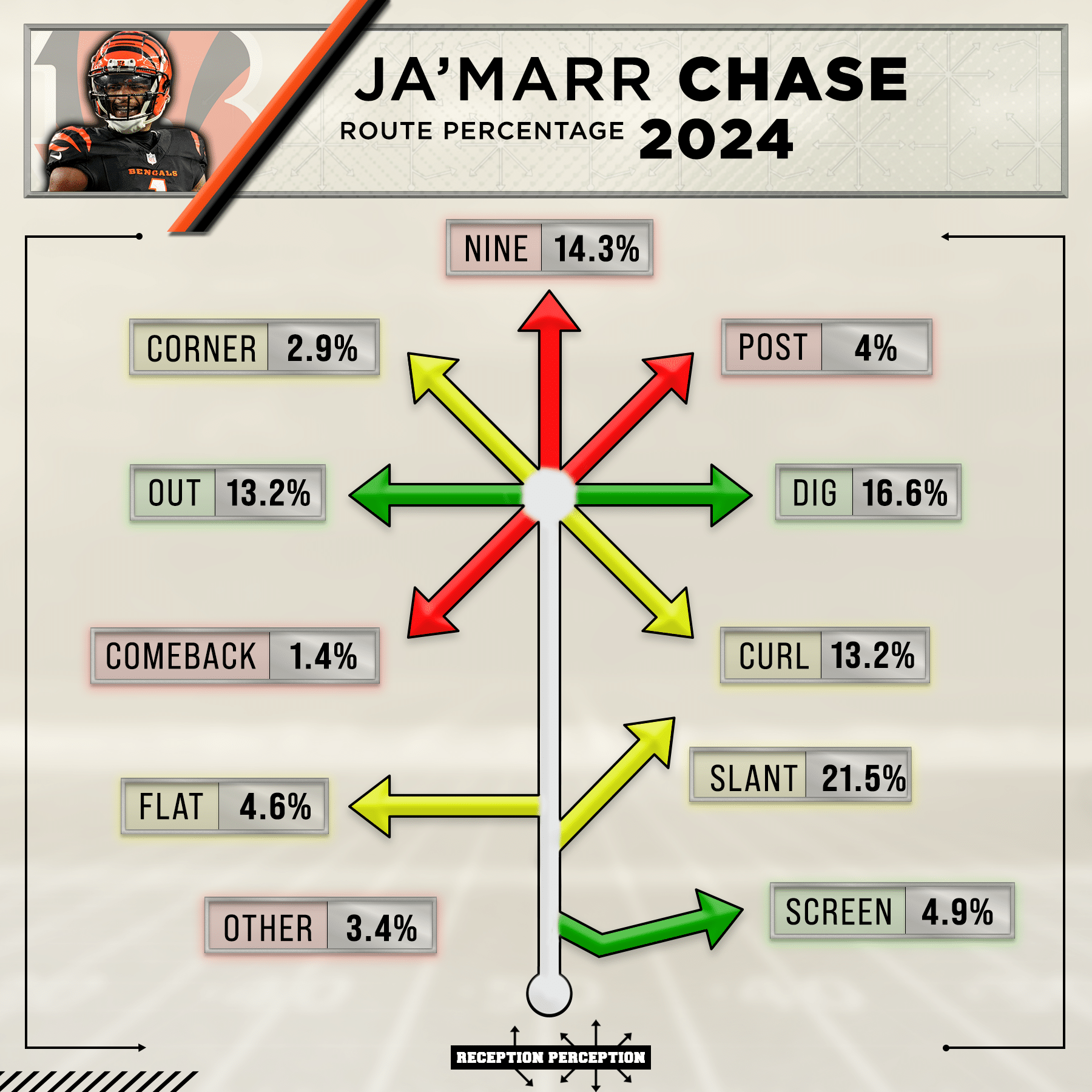
Route Percentage
Success Rate vs. Coverage
In his 2023 RP profile, I provided an in-depth examination of why I expected Chase, who entered the league as a pure X-receiver, to get the most dynamic deployment of his career in 2024. This was not only because I had a conversation with Chase earlier that year about the work he was putting in to earn the right to move around the formation and play in the slot more often, but you could see the signs coming on film in 2023.
That’s exactly what played out in his fourth season. Chase took 26.9% of his sampled snaps in the slot and 5.5% in the backfield, both of which were career-highs. He’s graduated from being a great perimeter option to a master of all three positions. His snaps off the line of scrimmage have ticked up from 14.3% as a rookie to 40.2% and 40% in each of the last two years.
Playing so much off the line and in the slot or backfield has allowed Chase to be in motion at the snap more often and a much more difficult player to defend. Back in 2022, when he was still mostly an X-receiver, Chase was doubled on a whopping 19.2% of his charted routes and saw press on 36.5%. This past season, despite Tee Higgins not playing in all the games, Chase was only doubled on 11.2% of his routes and saw press on fewer than 30% of his routes for the second consecutive year.
When you have an elite receiver, it is downright irresponsible to not alter their deployment over the years as the Bengals have with Chase, especially when the player, as highlighted in the interview with me above, is hungry to learn the intricacies of all the possible alignments. It should be noted that the Bengals are unique in having Tee Higgins alongside Chase as a guy who is also perfectly capable of handling big-boy thankless X-receiver duties in the moments the WR1 gets to move all around. Still, not having someone exactly like that isn’t an excuse for keeping your No. 1 wideout so static. Also, you can find guys in Higgins’ archetype. They may not be as good when you throw them the ball; that’s a taller task, but even if they’re closer to a sacrificial X-receiver, it allows you to maximize your alpha wideout. The reality is that deploying your receiver in this way doesn’t lock them into a Triple Crown, but it, without question, makes their lives easier and can take them to new heights in the stat sheet and as an isolated performer.
That sort of breakthrough season to the peak of this position is precisely what Reception Perception can confirm Chase experienced in 2024.
Chase had scored a 75.3%, 75.3% and 75.4% success rate vs. man coverage in each of his first three seasons. Excellent results, especially in the context of a route tree that contained such a heavy diet of vertical routes. However, in 2024, he broke through to a new level, finishing with a 77.4% success rate vs. man coverage, falling at the 93rd percentile. That puts him right in range with guys like Justin Jefferson and CeeDee Lamb, who had previously been better overall separators. Chase closed the gap and, while I’ve long maintained he should be, now must be mentioned among the best route runners in football.
Perhaps more notable, Chase has improved his ability to win against zone coverage every year he’s played in the league. He’s gone from 78.6% as a rookie to 80.5%, 82% and now ripped all the way up to a massive 84.3% success rate vs. zone last year. That puts him with some of the best zone-beaters charted for Reception Perception. There’s no doubt Chase’s route percentage chart looks so much more different than his 2021 and 2022 versions, and that contributed to getting better at beating zone underneath and intermediate. However, as Chase mentioned in our conversation, wide receivers must earn the trust of the coaching staff to play in this type of role. So in the end, the credit must always go back to the player. And it certainly should in this case study for how Chase broke through to being a top-level receiver against zone coverage.
While Ja’Marr Chase has always been an excellent receiver at releasing from the line of scrimmage and getting on top of press coverage all the way from his prospect profile to the moment he entered the NFL. Despite seeing press at a high rate, he’s cleared an 80% success rate vs. press in each of his first three years in the league. As you might have guessed, he shot well past those previous benchmarks to post an 84.5% success rate in 2024, which trailed only Justin Jefferson among charted wideouts last year and falls at the 98th percentile from a historical standpoint.
Let’s revisit Chase’s charting prospect profile once more. I had him ranked as a Tier 1 prospect and the second-highest ranked wideout (Marvin Harrison Jr. is No. 1 because he has the highest floor of any receiver prospect I can remember), I’ve evaluated, in part because he was just great at every facet of playing wide receiver. But also, since you saw evidence that “Chase ran against hard, tight coverage as LSU’s X-receiver and obliterated it as a mere sophomore.” He didn’t have some Mickey Mouse college receiver role boosting his success rates; he was doing NFL receiver work, running big-boy downfield routes against press coverage and winning at a well-above-average rate. If he remained dedicated to the craft, he would become an elite wide receiver. As we can clearly see, that dedication was planted, watered, and has grown into being a ferociously gifted separator at all three levels from every alignment imaginable.
On the note of being just great at every facet of playing wide receiver, Chase also had a stellar showing in his hands and tackle-breaking RP metrics.
Chase was “in space” on 58.2% of his sampled catches in 2024; a career-high 39 receptions total. He went down on first contact on a mere 35.9% of his plays in space, which was the lowest rate through four seasons. If you rank Chase as the best wide receiver in football, it’s likely because he is as good as or at least in the same neighborhood as some of the best separators and route runners in the sport, but is also uniquely able to take a short pass and house it like a speed-merchant gadget receiver. That’s as rare a combination as it gets.
At the catch point, Chase dropped just 4.3% of his sampled targets and turned in a 75% contested catch rate. However, it’s worth noting that he only saw a contested target on 8.6% of his sampled looks, by far the lowest of his career. The previous low mark was 21.3%.
The fact that Chase saw the most plays “in space” and the fewest contested targets of his NFL journey to date last year is just another result of the altered deployment and the benefits it brings to a wideout like Chase.
Ja’Marr Chase’s 2024 Reception Perception profile was a treat to work on. Not only was it one of the best recorded in RP history overall, but it was also a perfect testament to the years of work he had put into the craft, in addition to a test case for making all great receivers’ deployment more dynamic. Frankly, if you’re a coaching staff that has a player even close to this territory and you’re not following this blueprint, you’re leaving meat on the bone and just flat-out doing it wrong.
The fact that Chase is this good to put up such a stellar profile and is still only 25 years old is terrifying. You can argue he’s just getting started.